Complete Audio Visual and Security Solutions: From Auditoriums and Conference Rooms to Smart Home Theaters
Walk into any well-designed space today and you’ll notice it before you can explain it. The sound doesn’t fight you. The lighting doesn’t feel like an afterthought. Nobody’s fumbling with three remotes trying to start a movie. That’s not luck. Someone planned it.
Whether it’s a 500-seat auditorium or a home theater tucked into a spare room, the gap between “we bought good equipment” and “this actually works” comes down to one thing: integration. Cameras, speakers, screens, lighting, control systems on their own, they’re just boxes. Put together by someone who knows what they’re doing, they become something people barely notice they’re using. Which, honestly, is the whole point.
That’s the role of an Audio-visual system integrator. Not a salesperson pushing the newest display. Someone who looks at a room its size, its acoustics, who’s going to use it and how often before a single cable gets run.
Where This Gets Complicated
Here’s what catches people off guard: a great projector can still look terrible. Put it in a room with the wrong ambient light or pair it with underpowered speakers, and the specs on the box stop mattering. Same story with microphones that pick up every echo in a boardroom, or cameras aimed at a spot that gets blown out by sun every afternoon at 3pm.
Nobody buys bad equipment on purpose. They just don’t think about the room first.
A decent integrator will ask annoying questions before quoting anything: how big is the room, really, how many people, what’s on the walls, is there a network that can handle six extra cameras. It’s tedious. It’s also the difference between something that works in five years and something you’re replacing next spring.
Auditoriums Are Their Own Beast
There’s no room less forgiving than an auditorium. Two hundred people, all expecting to hear the same speech at the same volume front row, back row, doesn’t matter. Get it wrong and you’ll hear about it before the event’s even over.
Auditorium sound system and lighting supply and installation has to start with the room’s actual shape, ceiling height, seating rows, how sound bounces off a hard back wall versus a soft curtain. Line-array speakers work in some rooms; distributed speaker zones work better in others. There’s no universal answer, which is exactly why so many auditorium installs go wrong. Someone applied a template instead of measuring the room.
Lighting’s no easier. Presenters need to be visible without blowing out the screen behind them. Get that balance right and one person running a single control panel can handle sound, lighting, and displays without breaking a sweat mid-event.
Conference Rooms Aren’t What They Used to Be
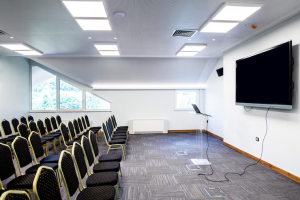
Ten years ago a conference room meant a projector, a phone, and someone yelling “can you hear me?” into a speakerphone. Now the same room needs to run client pitches, hybrid meetings, training sessions, and interviews sometimes all in one day.
A proper Conference room Audio visual setup isn’t complicated to describe: a good display, a camera that doesn’t make everyone look like they’re in a hostage video, mics that actually catch the person at the far end of the table, speakers instead of laptop audio, and a control panel simple enough that nobody has to call IT before a 9am meeting.
That last part matters more than people think. The fanciest room in the building is useless if the marketing team can’t figure out how to share their screen. Simplicity isn’t a nice-to-have here, it’s the actual design goal.
And acoustics still trip up rooms that look flawless on paper. Echo, background hum, a mic buried under someone’s laptop, a $4,000 camera won’t save a call from any of that.
Then There’s the Home Theater Crowd
People don’t just want a big TV anymore. They want the lights to dim, the curtains to close, and the sound to hit like an actual cinema without touching more than one button.
A well-built Smart home theater Audio visual setup usually means a serious display or projector, real surround sound (not a soundbar pretending), an AV receiver that can drive it, subwoofers that don’t rattle the neighbors’ walls, some acoustic treatment, smart lighting, and motorized blackout curtains tied together so one command does all of it at once.
That last bit is the whole trick, honestly. Anyone can buy a good projector. Making it feel like a theater where everything happens at once, without you thinking about it is what separates a home theater from a room with a big TV in it.
Security Isn’t Optional Anymore
Cameras on a wall don’t make a security system. That’s the mistake people make constantly: mount a few units, call it done, move on. Real Video surveillance system supply and installation starts with questions most people never think to ask: What actually needs watching? Is it dark there at 6pm? Do you need to just see activity, or identify a face? Indoor hardware, outdoor hardware not interchangeable. How long does footage need to sit before it’s overwritten? Can the network even carry that much data without choking?
A wide camera covering a parking lot works fine until someone needs to identify a face at the gate, and the footage turns out to be a blur. Get the retention period, resolution, and storage size wrong from day one, and you’re stuck rebuilding a system that should’ve lasted years.
Why the Integrator Matters More Than Any Single Product
You can buy the best display on the market and still end up with a room that doesn’t work because nobody made sure it talks to the microphones, or the conferencing platform, or the lighting rig next to it. That’s the actual job of an Audio-visual system integrator: planning, sourcing, installing, testing, and making sure four different manufacturers’ equipment behaves like one system instead of three unrelated headaches stacked on top of each other.
Build for the Person Who Has to Use It
A room with forty features and one confused employee isn’t a win. Neither is a home theater with four remotes on the coffee table. Good AV design is almost invisible. The stuff people use every day should be the easiest part, full stop.
Every Space Wants Something Different
Offices lean on conference systems, presentation displays, video calls, digital signage, and centralized control. Schools need classroom AV, lecture capture, PA systems, and campus-wide surveillance. Hotels and venues want distributed audio, signage, and security that doesn’t intrude on guests. Homes combine theaters, multi-room audio, lighting, and cameras into one system run from a phone. Industrial sites need heavier surveillance, control rooms, and communication infrastructure that can’t afford downtime.
Piecemeal Systems Cost More Later
Install everything separately and you inherit separate problems, nothing talks to anything else, upgrades become a nightmare, and maintenance means calling five different vendors. Planning it as one system from the start audio, video, lighting, control, network, security and expansion later is a lot less painful, because the groundwork was already there for it.
Picking the Right Partner
Skip the spec-sheet comparison for a second and ask the boring question: can this company actually run the whole project? Site visit, design, sourcing, install, programming, testing, training, support after the fact all of it, not just the parts that are easy to quote.
And ask if they’ve actually done a job like yours before. A team that’s great with home installs might not be ready for a 400-seat auditorium. That’s not a knock on them, it’s just a different job.
Satin AVS
Satin AVS handles audio visual and security work the way it should be handled around the actual space, not a generic package. Corporate offices, conference rooms, home theaters, industrial sites the approach doesn’t change: understand the room first, then build.
Need Auditorium sound system and lighting supply and installation? An Audio-visual system integrator who’ll actually ask the right questions? A Smart home theater Audio visual setup that doesn’t need a manual? A Conference room Audio visual setup your team can actually use? A Video surveillance system supply and installation built around your property, not a template? That’s the work.
Bottom Line
None of this technology works well by accident. Auditoriums, conference rooms, home theaters, security systems all live or die on planning, not just equipment. Get an experienced integrator involved early, and audio, video, lighting, and security stop being separate purchases and start being one system that actually holds up.
If you’re trying to build something reliable instead of just impressive-looking, that’s where Satin AVS comes in.
FAQs
1. What does an audio visual system integrator do?
An Audio-visual system integrator plans, sources, installs, and tests multiple AV systems so they run as one not as separate pieces someone has to babysit.
2. What’s actually in an auditorium AV system?
Speakers, mics, amplifiers, signal processors, screens or projectors, stage lighting, and a control system tying it all together.
3. What does a conference room AV setup include?
A Conference room Audio visual setup typically covers displays, a conferencing camera, mics, real speakers, wireless screen sharing, and one control panel simple enough that meetings actually start on time.
4. What goes into a smart home theater?
A Smart home theater Audio visual setup usually means a strong display or projector, surround sound, an AV receiver, subwoofers, acoustic treatment, smart lighting, and motorized curtains controlled from one place.
5. Why does professional surveillance installation matter?
Because Video surveillance system supply and installation done properly means cameras are placed where they’re actually needed, recording is set up correctly, and the footage is usable when someone actually needs it.